Dark to your clock.
Bright to your eyes.
The cells that set your body clock respond to one narrow band of blue-cyan light (440-495nm). An ordinary warm bulb still carries it. OIO engineers the blue signal out while keeping the rest of the spectrum intact.
Same warm white. Different signal.
Normal Bulb at Night
Dim to Dark
OIO Night Mode
Same color.
New signal.
Two lights can look the same warm-white color to your eyes but carry completely different spectral signals to your clock. OIO uses this principle to hit warm white while removing the blue your clock reads.
Spectral range: 800-6500K (deep ember to full daylight). Dims to 0.01%.
Not two white LEDs.
Most "tunable white" products mix a warm LED and a cool LED. The result shifts the apparent warmth of the light, but it does not independently control the melanopic band. OIO uses a multi-channel spectral engine to reshape the full spectrum, controlling the biological signal separately from the visible color.
Infinite spectra from 800K to 6500K
Melanopic band controlled independently of color
CRI 95+ across the full range
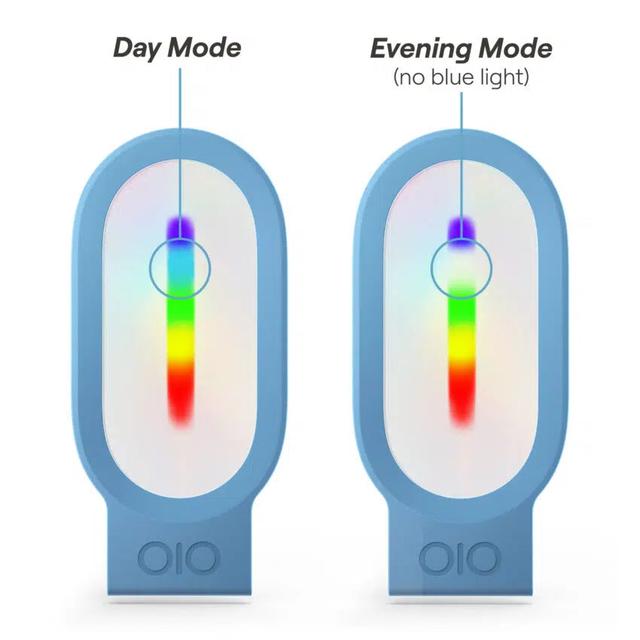
OIO Loop
See the blue disappear.
A pocket diffraction grating in a holder. Look at any light through it and its spectrum spreads into a rainbow, so you can watch OIO pull the blue out at night with your own eyes.
1000 lines per millimetre. First-order spectrum from 23.6 degrees (violet) to 44.4 degrees (red). Focus on the 440-495nm band: the exact range your circadian system reads.
Included free with every OIO order.
Built on a Nobel Prize.
Protected by 500+ patents.
OIO descends from Shuji Nakamura's 1990s gallium nitride LED, the breakthrough that earned the 2014 Nobel Prize in Physics. From that foundation: Soraa, then Korrus and Ecosense, then OIO. 108 granted US patents span spectral tuning, melatonin-response sources, circadian-friendly LED design, dim-to-warm systems, and machine learning for light.